HR Boost - HR Management Platform
About project
HR departments are the heart of every company — but they’re often buried in spreadsheets, scattered tools, and manual tasks.
HR BOOST was built to change that: a human-first, all-in-one HR ecosystem designed for small and mid-sized teams. From hiring and onboarding to time tracking, performance, and culture — it brings everything under one intuitive roof.
Instead of juggling systems, HR leaders can focus on what truly matters: supporting people, building culture, and growing teams with clarity and confidence.
Main goals of the project
- Unified HR Solution: Provide a one-stop platform that brings together recruitment, onboarding, employee data management, time-off tracking, and performance management in one place. No more jumping between multiple tools or sheets – everything HR needs lives in HR BOOST.
- Automation & Efficiency: Greatly reduce manual work by automating routine HR processes (e.g. approving leave requests, generating reports) and sending smart reminders. This increases productivity and eliminates errors – a key benefit since HR software users have reported significant time savings (69% saw faster payroll processing after implementation)
- Improved Employee Experience: Make HR interactions more engaging and employee-friendly. Through self-service features and transparency, employees can access payslips, submit requests, and receive feedback easily – leading to higher satisfaction and engagement. Happy employees and efficient HR go hand-in-hand, improving retention and company culture.
- Data-Driven Decisions: Turn HR data into actionable insights with built-in analytics. By tracking metrics like turnover, attendance, and performance, the platform helps HR directors and founders make informed decisions. HR BOOST’s goal is to give even a small company the kind of HR intelligence that big enterprises have – leveling the playing field for strategic decision-making.
- Compliance & Security: Ensure that sensitive employee information and HR processes are secure and compliant. HR BOOST was built with strong permission controls, data encryption, and up-to-date labor law compliance features. This provides peace of mind that records are accurate and the company stays compliant with regulations effortlessly.
Challenges and solutions

Challenge: Scattered data led to outdated records and compliance risks.
Solution: HR BOOST became the single source of truth. With role-based access, audit logs, and smart reminders, HR stays compliant and secure by default.
Challenge: HR tools are often clunky or too complex.
Solution: HR BOOST was built with actual HR teams, featuring a clean UI, setup wizards, and customizable workflows. Easy to learn, even easier to love.
Challenge: One-size-fits-all platforms can feel bloated.
Solution: HR BOOST is modular by design. Every feature shares data, yet works independently. You get only what you need, and it scales when you do.
Challenge: HR tasks lived in spreadsheets and inboxes, causing mistakes and burnout.
Solution: We digitized everything. Online forms, automated workflows, and instant notifications replaced paperwork. HR now runs on autopilot.
Functionality

Features that make this project unique
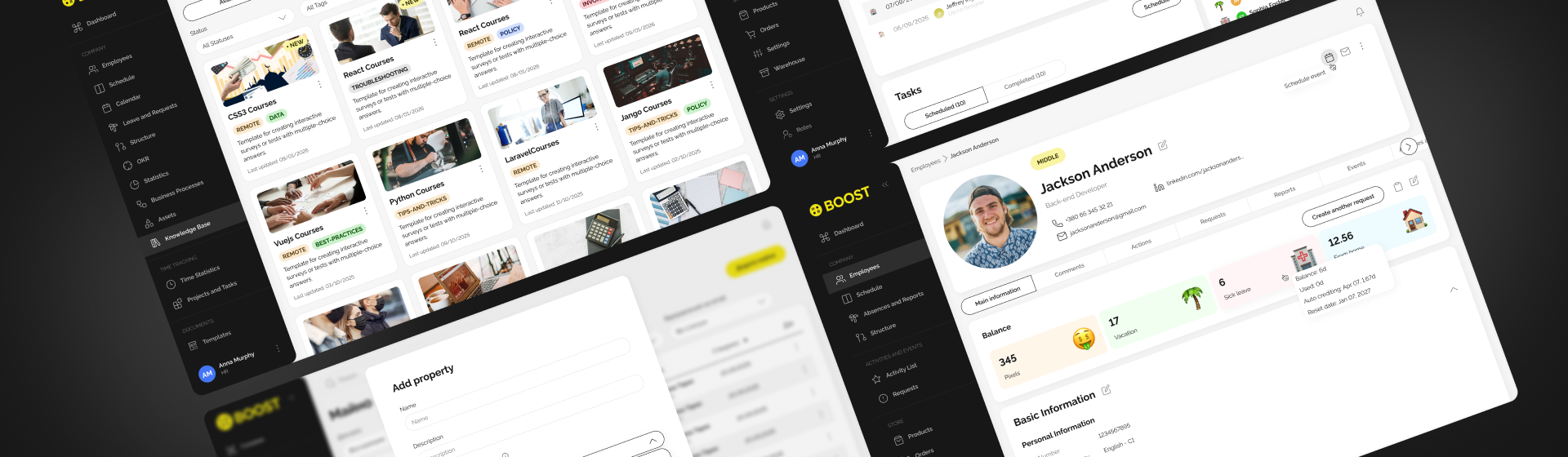
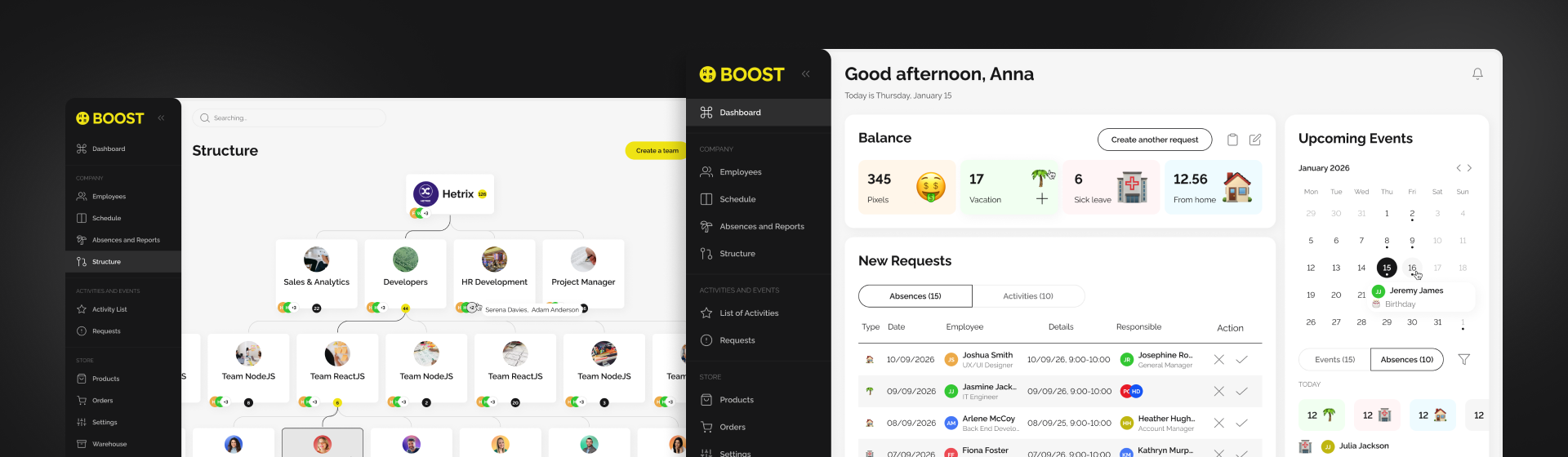
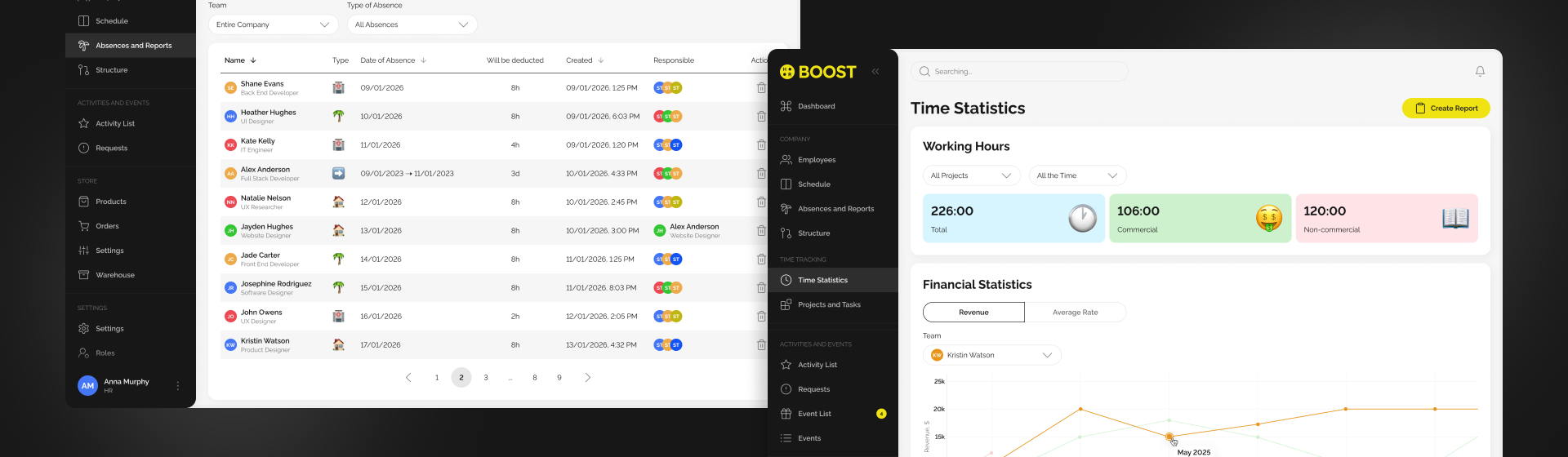
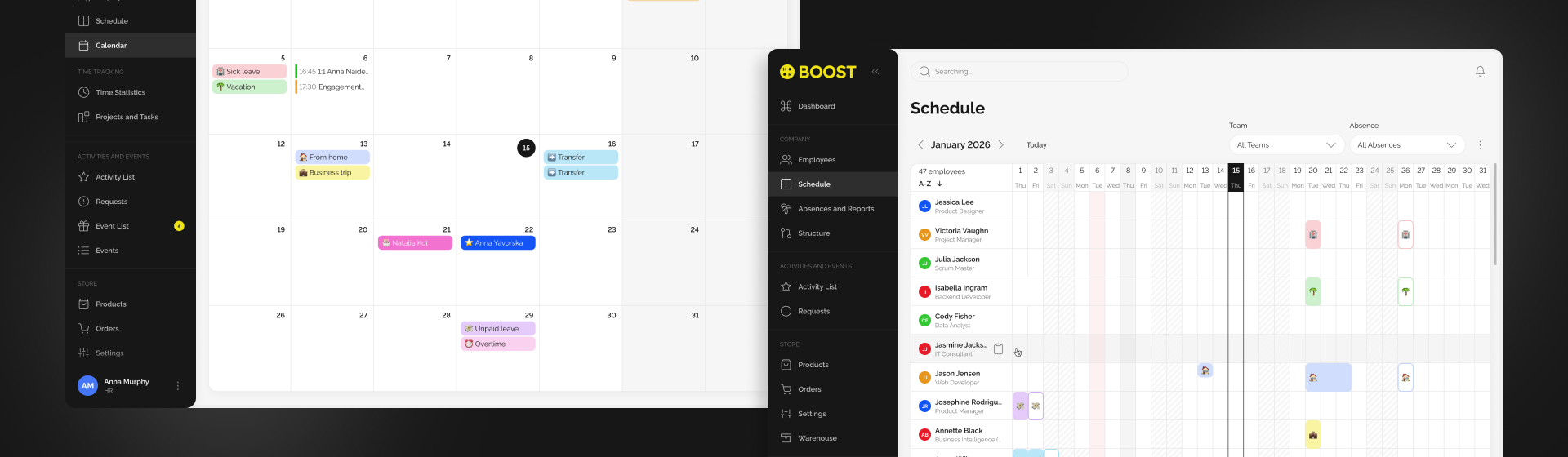
Unlike many HR solutions that handle only one or two functions, HR BOOST covers the full spectrum – hiring, core HR, time off, performance, and more – in one platform. This all-in-one approach means companies (especially small businesses) don’t need to purchase and juggle multiple tools. Yet, HR BOOST’s modular design ensures it’s not bloated: each feature set is well-integrated and can be turned on/off as needed, providing a tailored solution for each client.
HR BOOST was built with a people-first philosophy. The interface is clean and modern, with an experience more akin to a friendly consumer app than old enterprise software. From mobile access (so you can approve requests or check info on the go) to thoughtful touches like automatic email reminders and a friendly chatbot for guidance, the platform emphasizes ease-of-use at every step. This high adoption rate and positive user experience set HR BOOST apart from rigid legacy HR systems.
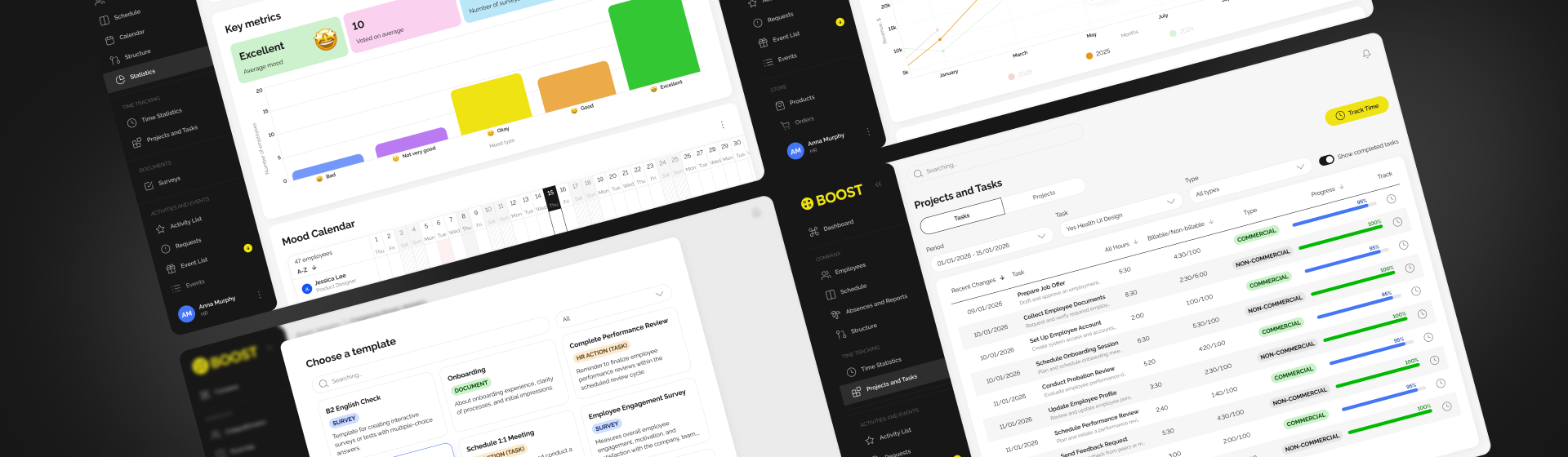
A standout feature of HR BOOST is its use of intelligent automation and insights. The system doesn’t just collect data, it actively helps you use it. For example, HR BOOST can send proactive alerts (“⚠️ John has only 2 vacation days left for the year”) and suggestions (like flagging if a team’s overtime is abnormally high this month). By leveraging built-in rules and analytics, the platform acts like a smart assistant for HR teams, predicting needs and surfacing important information before you even ask.
Tech stack
 Typescript
 NextJS
 Axios
Axios
 React
React
 React-query
 antd
antd
 Jest
Jest
 Phaser
 Zustand
 Prettier
 TypeORM
 NestJS
 Socket.io
 Postman
 RESTful APIs
 OAuth
OAuth
 JWT
JWT
 rxjs
rxjs
 PostgreSQL
 DataGrip
 Swagger
 TypeORM
 S3
S3
 AWS SDK
 Gitlab CI/CD
 Docker
 nx
nx
 Husky
Husky
 Figma
FigJam
Figma
FigJam
 Adobe Photoshop
 Trello
 Notion
Optional features that can be added to similar project types
Although HR BOOST focuses on core HR management, a payroll and benefits administration feature can be integrated for companies that want a truly end-to-end HRMS. This would automate salary calculations, payslip generation, tax withholdings, and benefits enrollment – eliminating the need to export data to an external payroll system.
For businesses with high volume recruiting needs, an AI-driven resume screening and candidate ranking system could be added. This feature would use algorithms to scan CVs and highlight the best matches for a job, saving recruiters time and helping ensure no great candidate is overlooked. It could even analyze past hiring data to continually improve its recommendations.
A conversational chatbot could be integrated into HR BOOST to handle common employee queries and HR tasks via chat. For example, employees could ask, “How many vacation days do I have left?” or request time off through the bot. The HR virtual assistant could also help HR staff by fetching data or reminding them of upcoming tasks (“Your meeting with the new hire is in 30 minutes”).
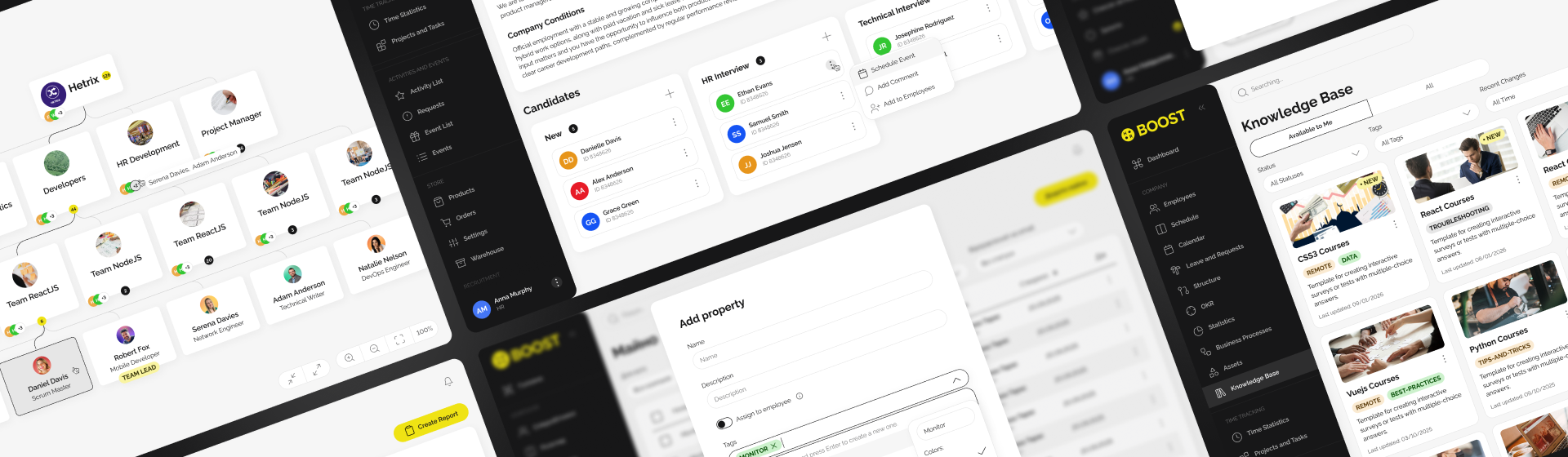
To round out the employee lifecycle, an optional Learning & Development module or integration can be provided. This would allow HR to assign training courses, track completion, and even host internal knowledge bases or quizzes. Investing in employee growth via an LMS ties in with performance management and helps companies upskill their teams within the same platform.
Let's work together to make your project a success
Thank you!
We’ve received your contact request and will contact you soon
Something went wrong
We couldn’t receive your contact request. Please try again later.