PoC vs MVP vs Prototype: What’s the Difference?
PoC, Prototype, or MVP? Pick the wrong one and you’ll waste time and money building the wrong thing. Let’s clear the confusion and help you choose the step that actually makes sense for your product.
16 April, 2026
PoC vs MVP vs Prototype: What’s the Difference?
If you’re building a new digital product – an app, SaaS tool, marketplace, internal platform, anything – you’ll always hit the same question:
“Where should we start: PoC, Prototype, or MVP?”
People often mix these up, and it’s not their fault. The terms get thrown around in every pitch deck, product meeting, and investor conversation.
And choosing the wrong one can waste time, money, and more brain cells than assembling IKEA furniture.
So, let’s break it down.
1. What Is a PoC (Proof of Concept)?
Goal: Check if your idea is technically possible before you invest heavily.
A PoC is basically you saying:
“Before we build a whole product, let’s make sure the key technical part actually works.”
A PoC is not a mini-product.
It’s not pretty.
It’s not something you show customers and investors.
It’s not meant to scale.
It’s just meant to say: “Yep, the idea is doable,” or “Nope, this will explode, let’s rethink it.”
Think of it as a scientific experiment before you commit to full development.
How a PoC Works
A PoC focuses on the one thing that really matters: proving that your unique features can actually work.
It is usually built in a short timeframe (a few days to a few weeks) and focuses only on the riskiest technical assumptions.
The process usually looks like this:
- Identify the risky or unknown part – the algorithm, integration, automation, or performance requirement. That “one thing” that could break the whole project.
- Build a small test implementation – often ugly, sometimes hacked together, intentionally limited. It can be a script, a microservice, a model sample – whatever proves or disproves the idea.
- Run it with real conditions – actual files, real data, expected load.
- Check the results – does the tech behave the way we need it to?
- Decide next steps – move forward, pivot, or kill the idea early and save the budget.
Keep in mind that a PoC proves possibility, not usability.
PoC Best Practices
- Validate assumptions early. Every month you wait increases cost and reduces optionality.
- Test like it’s production but build like it isn’t. Quick, dirty code is okay – it’s a test, not part of the final architecture. But test conditions must be real.
- Define measurable success metrics. “It works” is not a metric. “Response time under 120ms” is.
- Test one hypothesis at a time. “Can we do X?” Not “Can we do X, Y, and maybe Z?”. Focus on the riskiest part first.
- Document everything. Future you and your dev team will thank you.
- Keep it small and focused. PoCs that grow into mini-MVPs kill budgets.
- Time-box the effort. If it takes months, it’s no longer a PoC – it’s a money pit.
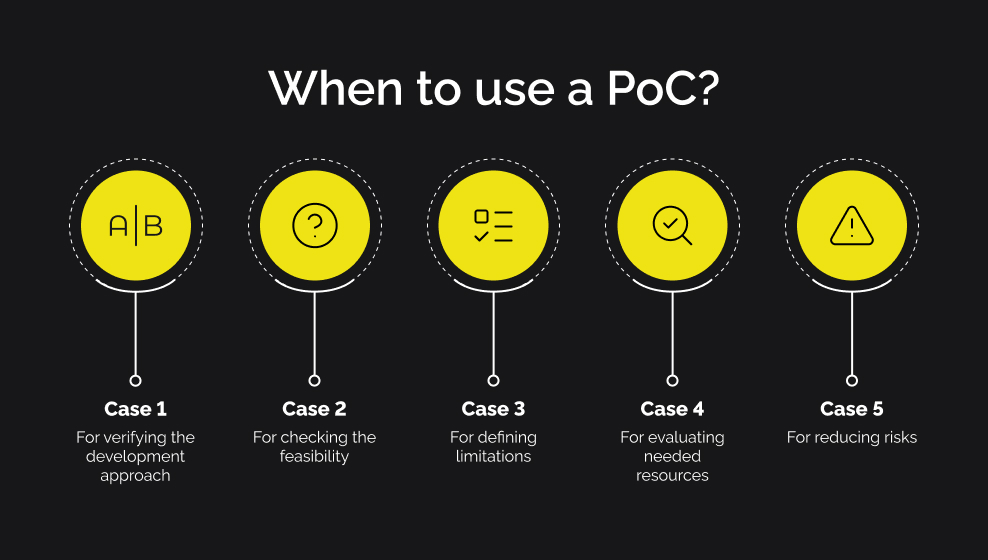
Remember, a PoC answers the question: “Should we even try building this?”
If yes then we move to the next stage.
2. What Is a Prototype?
Goal: Visualize your product and test the user experience before writing code.
Unlike a PoC, a Prototype is user-facing. It focuses on experience, not functionality. It’s like showing someone the packaging of a gift without the gift inside yet.
Its job is to answer questions like:
- Is this what the product should look like?
- Does the flow make sense?
- Can people understand how to use it?
It’s your future product in visual form – clickable, realistic, and perfect for getting feedback early.
How a Prototype Works
Prototyping usually happens in design tools like Figma and focuses on user interaction, layout, and structure.
The process includes:
- User flow mapping — what steps users take and what screens they see
- Wireframing — simple, low-fidelity drafts
- Visual design — colors, layouts, UI
- Clickable prototype — simulates real product behavior
- User testing / stakeholder feedback
A Prototype is the safest way to see your product in action before investing in development. No code. No backend. Just experience.
Prototype Models
There are several types of prototypes, depending on the goal:
1. Low-Fidelity (Lo-Fi) Prototype
Rough sketches or simple wireframes.
Useful for quick brainstorming or validating flows.
2. High-Fidelity (Hi-Fi) Prototype
Full UI design with colors, animations, and branding.
Perfect for pitches and testing real user behavior.
3. Interactive Prototype
Clickable version simulating real product navigation.
Great for demos, investor decks, and usability testing.
4. UX Prototype
Focused on flow and logic rather than visuals.
Used early in discovery.
5. Functional “Fake” Prototype
This one mimics logic using no-code tools.
Helpful for early customer demos.
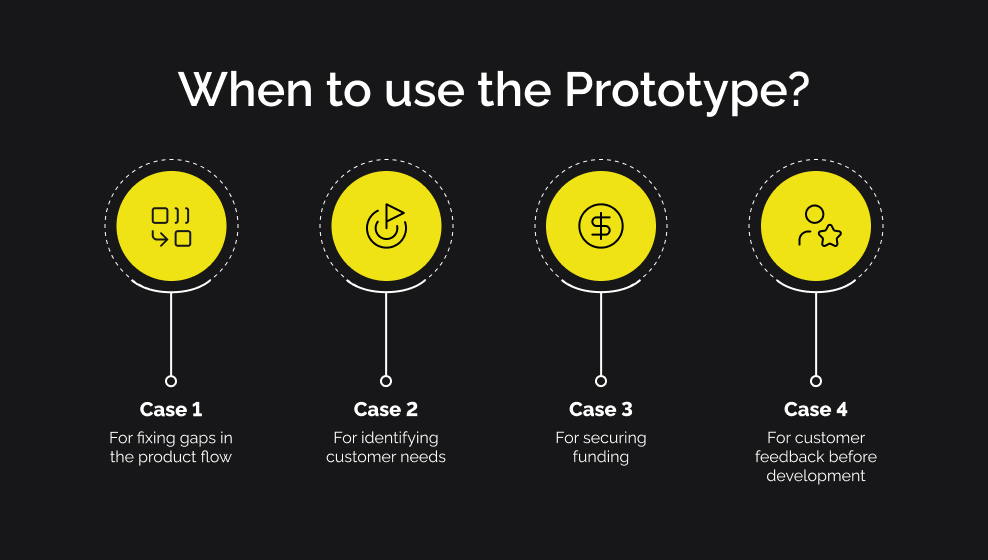
A Prototype shows whether users get it and whether they enjoy using it.
The next step? Turning this pretty concept into something real.
3. What Is an MVP (Minimum Viable Product)?
Goal: Launch a real, usable version of your product to test market demand.
Now we get to the point where you actually build something functional.
If PoC answers “Can we build it?”
And Prototype answers “Will users understand it?”
Then an MVP answers: “Will people actually use this and pay for it?”
An MVP is NOT a prototype. It’s a real product, just with the “nice-to-haves” removed. It’s the first version you release to real users. It delivers real value and proves whether your idea has traction.
How an MVP Works
Creating an MVP typically involves:
- Identifying the core problem your product solves
- Choosing only the essential features
- Developing them with production-quality code
- Launching to a limited audience
- Collecting feedback, measuring results
- Iterating and expanding
Main Characteristics of a Strong MVP
- Solves one core problem extremely well
- Has enough design polish to feel trustworthy
- Uses robust architecture for future scaling
- Reduces time-to-market
- Focuses on measurable outcomes
- Is ready for real user behavior
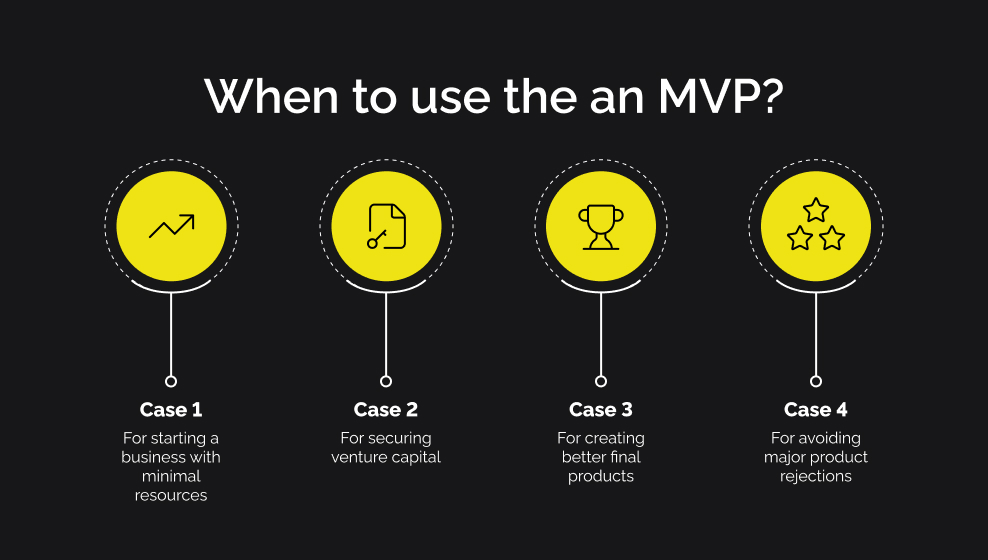
Building a new product is always risky. Around 35% of startups fail because they create something the market never really asked for.
Starting with an MVP helps you test the waters first. You save time and money, get real feedback, and quickly figure out whether to move forward, tweak the idea, or go back to the drawing board.
PoC vs. Prototype vs. MVP: What’s the actual difference?
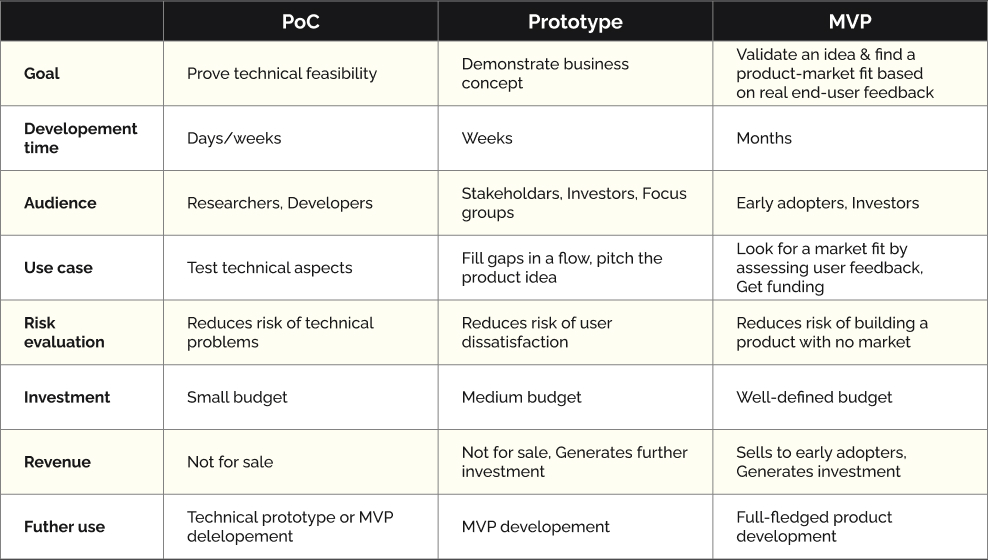
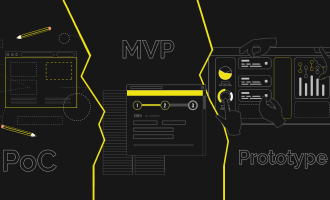
Think of these as just different steps in the product development journey. PoCs and Prototypes are the pre-product phases. They’re testing grounds that don’t require a massive budget or years of work.
An MVP is the next big step up. This is where you actually build the core version of your product to see if the market likes it. Naturally, building an MVP takes more time and money than just testing a concept or building a mockup.
Here’s a quick table to help break down the differences:
Wrapping Up
PoC, Prototype, and MVP aren’t just fancy product terms, they’re different tools for different moments. And choosing the right one can save you months of work, a lot of money, and a few grey hairs.
- If your biggest question is “Can this even work?”, start with a PoC.
- If you want to see the product and test the experience, build a Prototype.
- If you’re ready to launch something real and test the market, go for an MVP.
You don’t have to use all three. Some products skip straight to prototyping. Others need a PoC first because the tech is risky. And some go right into MVP mode because the idea is clear and the market timing is right.
The smartest approach is choosing the leanest step that reduces the biggest risk in front of you.
Every successful product starts with the right first step.
Choose it wisely.
And if you’re not 100% sure which one fits your case or how to build any of them – that’s what we’re here for.
Let's work together to make your project a success
Contact usRelated News


Last News
Thank you!
We’ve received your contact request and will contact you soon
Something went wrong
We couldn’t receive your contact request. Please try again later.